The Magic 8 Ball was not invented as a ball. It began as a cylinder built by the son of a Cincinnati clairvoyant, spent four years failing to sell, and only became the black sphere everyone recognises when a billiards company asked for a promotional gimmick.
The short version
- 1940s - Mary Carter, a clairvoyant in Cincinnati, reads for clients using a spirit-writing device known as the Syco-Slate.
- 1946 - her son, Albert C. Carter, builds a liquid-filled fortune-telling tube and calls it the Syco-Seer.
- 1948 - Carter dies; his business partner Abe Bookman keeps developing it.
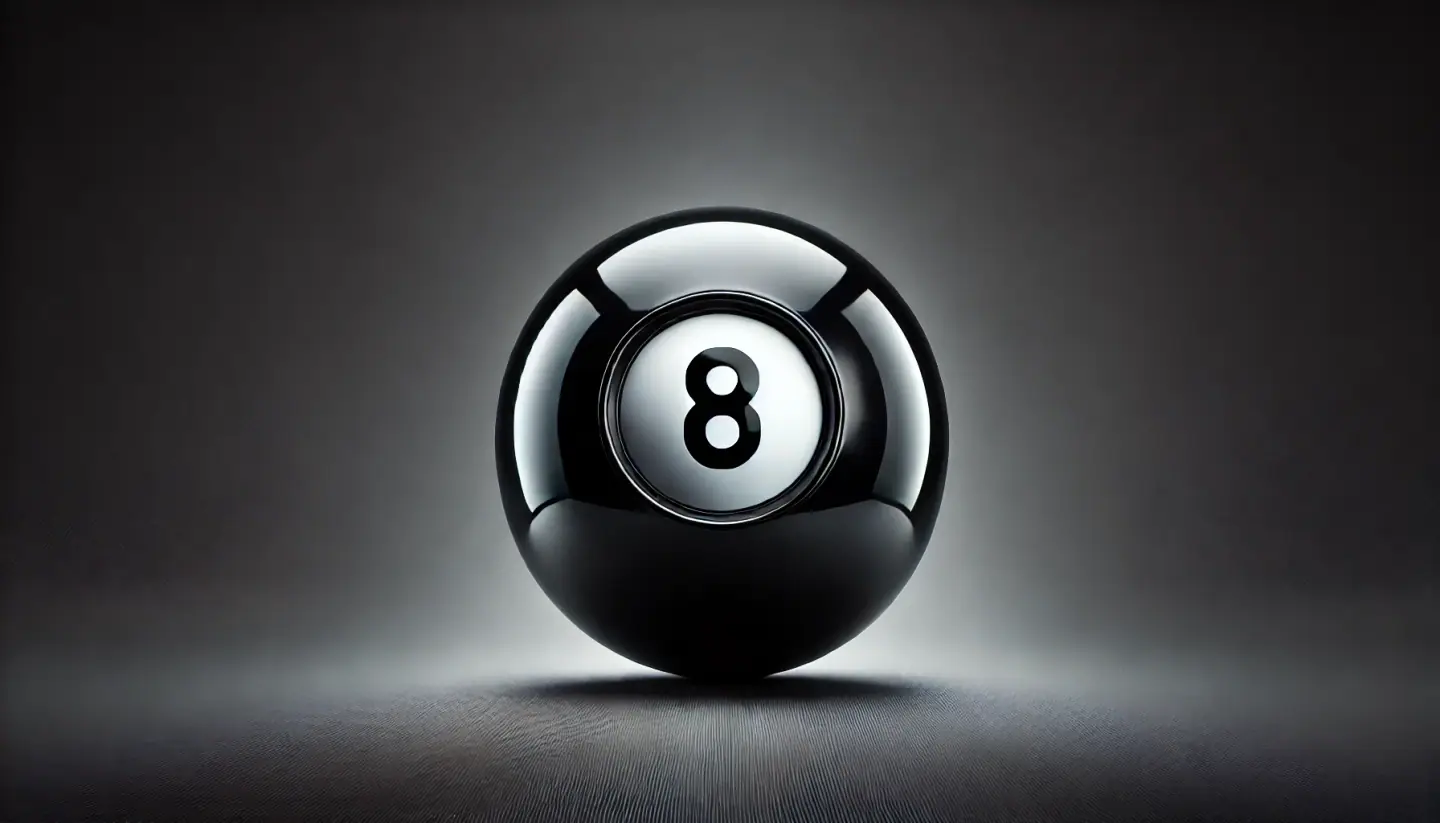
- 1950 - Brunswick Billiards commissions a version shaped like an eight ball. That shape is the one that sells.
- 1971 onward - the toy passes from Alabe Crafts to Ideal, to Tyco, and finally to Mattel, who make it today.
Mary Carter and the Syco-Slate
The idea did not start as a toy. Mary Carter gave readings using a slate on which messages appeared to write themselves - a piece of stage spiritualism common in the period. Her son grew up watching people pay for answers that arrived from somewhere they could not see, which is, in the end, the entire product.
1946: the Syco-Seer
Albert Carter's contribution was mechanical. Instead of a slate he used a sealed tube of dark liquid with a die floating inside it, so the answer surfaced on its own rather than being written. He called it the Syco-Seer, and it had a window at each end - two answers per device. He took it to Abe Bookman, a store owner in Cincinnati, and the two set up Alabe Crafts to make it. The company name is simply Albert plus Abe.
It did not sell. The tube was awkward, it looked like laboratory equipment, and nothing about it suggested you were supposed to enjoy it.
1948: Bookman takes over
Carter died in 1948, before the design had found an audience. Bookman kept working on it - he cut it down to a single window, which is why the modern ball shows one answer instead of two, and tried selling it in a crystal-ball housing. That did not work either. What was wrong was never the mechanism; it was that nobody knew what the object was for.
1950: it becomes an eight ball
The break came from outside the toy trade. Brunswick Billiards wanted a promotional item and asked for the device in the shape of a black-and-white eight ball. The disguise solved the whole problem at once: the eight ball was already a symbol for being in a bad spot with no good options - behind the eight ball - so the object explained itself. A fortune-telling toy shaped like the worst position on a pool table is a joke anyone gets instantly.
That is the version that has been in production ever since.
Who has made it since
Alabe Crafts sold the Magic 8 Ball to Ideal Toy Company in 1971. Ideal was absorbed by Tyco Toys in the late 1980s, and Tyco merged into Mattel in 1997, which is where the brand sits today. Through four owners and seventy-odd years the product barely moved: same shell, same liquid, same twenty answers.
What has and has not changed
The set of twenty answers has been stable since 1950 - ten affirmative, five non-committal, five negative. What drifts is typography: "Yes - definitely" and "Yes definitely", "Cannot predict now" and "Can't predict now" all appear across print runs. The full list, with what each answer means.
The mechanism is untouched too - a twenty-sided die floating in dyed alcohol, rising to a window. How that actually works, and what the inside looks like.
Seventy years on screen
The shape reads instantly, which is why writers keep reaching for it: an 8 Ball on a desk tells an audience the character is stalling rather than deciding. It has turned up in Toy Story, in Interstellar, in sitcom plots built entirely around trusting it, and in a permanent supply of internet jokes about consulting it instead of a professional. Very few 1950 toys are still legible enough to be used as shorthand.
The digital era
The one genuine change is where people use it. A browser version needs no shelf space and never clouds over, and it can reproduce the original exactly - the same twenty answers at the same odds. You can ask the Magic 8 Ball at the top of this site, free.